 Ваша оценка
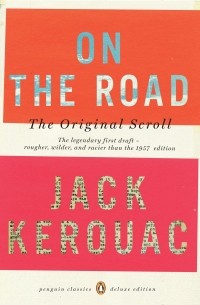
The legendary 1951 scroll draft of On the Road, published as Kerouac originally composed it
IN THREE WEEKS in April of 1951, Jack Kerouac wrote his first full draft of On the Road—typed as a single-spaced paragraph on eight long sheets of tracing paper, which he later taped together to form a 120-foot scroll. A major literary event when it was published in Viking hardcover in 2007, this is the uncut version of an American classic—rougher, wilder, and more provocative than the official work that...
Жанры
Издательство:
ISBN:
9780143105466
Год издания:
2008
Язык:
Английский
Paperback | 416 Pages
Introduction by Howard Cunnell, Penny Vlagopoulos, George Mouratidis and Joshua Kupetz
Возрастные ограничения:
18+
Интересные факты
In 2007, the fiftieth anniversary of the publication of Jack Kerouac’s On the Road, the original scroll on which the novel was based toured the country and was published for the first time in book form by Viking. This literary document, which was purchased for a record sum of $2.43 million, has taken on a mythology befitting its scripture-like appearance. According to the legend, after three furious and Benzedrine-fueled weeks in April 1951, Kerouac emerged from a New York City apartment with a complete novel of more than 120,000 words. The work represented a radical challenge to conventional literary tastes: it was typed on a 120-foot-long scroll of teletype paper and contained virtually no punctuation. After his publisher Harcourt Brace rejected it, Kerouac replied, “It was dictated by the Holy Spirit! It doesn’t need editing!” As the legend has it, the novel that was eventually published as On the Road six years later was but a tame, heavily censored version of the original.
The reality of the story is quite different. Howard Cunnell in his introduction to On the Road: The Original Scroll punctures several myths surrounding the scroll, including Kerouac’s use of Benzedrine (he took nothing stronger than coffee), its physical appearance (it was actually typed on long sheets of drawing paper not teletype paper), and its disregard of punctuation (it is for the most part conventionally punctuated). More importantly, the scroll did not emerge out of thin air ñ since 1947, Kerouac had made several attempts to begin his road novel, all of which he came to realize were false starts. During these years, Kerouac toyed with different titles (e.g. “Gone on the Road” and “Souls on the Road”) and different character names (Benjamin Baloon became Jack Kerouac, and Dean Pomeray became Neal Cassady). Furthermore, after Harcourt Brace rejected the scroll, he began immediately to revise it.
The scroll is in fact only slightly different and longer than the published novel. There are, however, a few key differences which impact the novel’s overall effects. First and foremost, the scroll is unparagraphed, an unusual but not unprecedented novelistic technique (see the Molly Bloom soliloquy in James Joyce’s Ulysses or Samuel Beckett’s Molloy, first published in French in 1951). While this makes for challenging reading, the unparagraphed scroll better mimics the ceaseless movement of its characters. Movement is an oft repeated theme in both the scroll and novel; Kerouac says at one point, “[we were] performing our one noble function of the time, move.” In addition, the scroll makes much more use of dashes and ellipses. Peggy Vlagopoulos, in her essay that accompanies the scroll, observes that the published novel often replaces these marks with commas, thereby interrupting the flow of the narrative. These typographical differences create a faster moving work but also a highlight Kerouac’s use of parataxis, a style in which one syntactic element is followed by another without an apparent hierarchy of importance. Hemingway famously used this in The Sun Also Rises, which helped accentuate the Lost Generation’s aimless movement from one bar or bistro to another. For Kerouac, writing in the age of the automobile, the style is quickened to capture the speed of the road and the characters’ restless search for one “kick” after another. To be sure, the novel contains many of these stylistic features but the scroll better illustrates Kerouac’s use of them.
Another difference readers will immediately discover in the scroll is that it identifies the characters by their real names. Even when his editors at Viking, fearing libel suits, insisted that they could not publish it without fictional names, Kerouac attempted to obtain signed releases from all of the major characters in the work. Many readers have considered On the Roadas an autobiographical novel but the scroll’s restoration of the original names makes this work come closer to a memoir. In its chronicle of the cross-country trips Kerouac, Cassady, Allen Ginsberg and others took from 1947 to 1951, the scroll anticipates the genre of literary nonfiction, as practiced by such writers as Truman Capote, Tom Wolfe, and Hunter S. Thompson, by some fifteen years.
Beyond these key differences, and the inclusion of a few minor characters and plot sequences, the scroll leaves a few passages in a raw but also more economical state than in the published novel. For instance, one of the most quoted passages in the novel reads in the scroll as follows:
“But then they danced down the street like dingledodies and I shambled after as usual as I’ve been doing all my life after people that interest me, because the only people that interest me are the mad ones, the ones who are mad to live, mad to talk, desirous of everything at the same time, the ones that never yawn or say a commonplace thing but burn, burn, burn like roman candles across the night.”
This is repeated nearly verbatim in the published novel until the ending which Kerouac finishes as: “burn like fabulous roman candles exploding like spiders across the stars and in the middle you see the blue centerlight pop and everybody goes ‘Aww!’ What did they call such young people in Goethe’s Germany?” To many readers this is an unfortunate revision, which only breaks up the mounting rhythm of the original.
By the time the novel was published in 1957, the world it chronicled had begun to disappear. As John Leland notes in hisWhy Kerouac Matters, with the completion of the Interstate Highway System in the late 1950s and the rise of hotel chains and fast food restaurants, cross county traveling would never again be quite as it was described in On the Road. In addition, bebop jazz, which influenced Kerouac’s own style and structure of the novel, began to lessen in popularity, giving way to rock n’ roll. More importantly, in 1957 Kerouac was a man of thirty-five, the author of a book that chronicled adventures of his mid-to-late twenties. Although he was canonized as a Beat saint, he did not feel himself to be a part of the generation that eventually embraced the book and took to the road. It was, therefore, not surprising that he distanced himself from the young Beatniks almost immediately upon the publication of On the Road.
Рейтинг LiveLib
3,7
15 оценок
- 520%
- 433%
- 347%
- 20%
- 10%
Ваша оценкаПрочитали 14Хотят прочитать 5
Рецензии
На эту книгу еще нет ни одной рецензии. Ваша может стать первой.















Цитаты
 Annly26 ноября 2024
 5 понравилось73
- Annly26 ноября 20245 понравилось42
- Annly26 ноября 20245 понравилось40