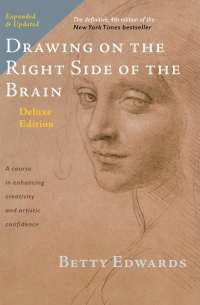
•R-mode is the visual, perceptual mode of the brain. We tend to use L-mode more often and it’s easier for us. The right hemisphere of the human brain is specialized for recognition of faces
•The magical mystery of drawing ability seems to be, in part at least, an ability to make a shift in brain state to a different mode of seeing/perceiving, an altered state of awareness
•initial tasks: draw a self-portrait, a person, drawn from memory, your hand. Date the pictures
•drawing from memory recalls simplified symbolic shapes from your mind
•drawing is activity confined to human beings and possible by human brain
•two hemispheres of brain have their own way of knowing as if a human had two consciousnesses. The main divisions are between thinking and feeling, intellect and intuition, objective analysis and subjective insight.
•Learning to draw makes people feel more "artistic" and therefore more creative
•the right hemisphere can start anywhere, it doesn’t have sense of time, it’s non-verbal, analogical, visual, intuitive
•try to write your signature in mirror writing
•draw face and make a vase out of it, there should be a shift from the l-mode to the r-mode (seeing the whole picture, feeling, not thinking)
•draw a picture upside down. You’ll be in the r-mode (focusing on shapes, how they connect, what these shapes remind you)
•draw some item which you see, look at it and don’t look at the list of paper for 5-10 minutes. Notice the complexity and the depth of texture, colors, light, shadow, connection with other elements
•when doing exercises ask: Which hemisphere gets to the job the quickest? Which hemisphere cares most or likes the task the best? Which hemisphere cares least and likes the job the least?
•if students pay close attention to negative spaces in their drawings, many compositional problems are automatically solved
•always start drawing from the Basic Unit, the main object which you will compare other objects with
•you can close one of your eyes to be able to build a 2D picture fast
•you can measure everything you see with your pen, but for that your elbow should be locked. You can also measure angles with the pen, if you hold the pen horizontally and check what angle it makes with the surfaces out there



 Ваша оценка