

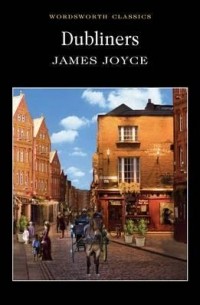
Отзывы о книге Dubliners
 little_ash11 декабря 2014
Joyce, so special.
'Dubliners' is a special book for me as I bought it and actually read first stories at Sweny's, a former apothecary where Leopold Bloom bought a lemon soap for his wife Molly on this so long and famous day described in 'Ulysses'. Today it has concerved the apothecary counter and bottles on the walls, and even the lemon soap for sale, and it added Joyce's books and souvenirs, and has become a place for literary readings I was lucky to attend. I got there as I was making Bloom's route in Dublin, and Sweny's, naturally, was one of the spots to visit, as it's one of those not really numerous real places mentioned by Joyce that still excisting. The amiable man on the other side of the counter invited me to make an inscription in a big book where visitors write who they are and where they are form. We spoke of my route and of the shop a bit, and he invited me to read 'Dubliners' in the evening.
It was the first time I've ever been to such readings. The host of the shop, a poliglot who spoke to me in almost all the languages I know (and he knows even more, I am sure), served tea to me and some other men and women who gathered to read one or two stories in the rainy evening. We read one by one, by paragraphs or bigger parts choosing stories on the spot.
We read 'Araby' and 'Eveline', and 'Clay', I guess. After each story sitting for some moments in silence, we felt some remorse, as if we entered a scene in the past, followed its heroes, like shades, and then it suddenly faded in front of us, leaving this feeling of empathy and, in some way, regret. And, at the same time, of something else: I remember clearly a woman, who sighed happily and said 'How brilliant'. I remember soft laughing heard when we read Penelopy episode from 'Ulysses' the next evening. Feeling every word, aware of Joyce's allusions and implications, the readers amazed me no less then the book itself. Then it seemed to me quiet, and somewhat descriptive, and loving. I saw Joyce writing about his native city as he knew it, from his exile, showing all the parts of it he knew so well, every aspect and detail, whether it was good or not.
However, now, as a year passed and I read all of the 'Dubliners' stories, I should say that it was an illusion, for Joyce never did anything without this deeper sense which sroke me in Ulysses so much. Reading O.Henry or any other novellist, I got used to concidering stories a simpler genre, with ideas quite clear to guess or read between lines as far as the story ends. Yet, 'Dubliners', though on the surface they may seem to be plain scetches about middle-class Dublin citizens, which often end abruptly and leave a reader with 'so what?' in his head, is a book full of 'scrupulous meanness', as Joyce himself puts it, about everything Ireland is ill with: Catholic Church dominance in education and thoughts, though not enlightening or leading its flock to anything decent anymore; emotional or functional paralysis of people and organizations they serve at, political hypocrisy, betrayal and inadequacy, and, on the other hand, bold enthusiasm; and, most generally, as it is mentioned in the Introduction to the book, the aspirations of most of the stories heroes, their longing to something: their past, their family, lust, spirits, and what not. Their longings, as well as their stories, mostly end in dissapointment and dissolusion, except, perhaps, one, 'The Dead' , where Gabriel's mind becomes reconciled with what he heard and felt, and the whole Ireland, with all her dead and alive, is reconciled as well by the snow which falls all around it. So Joyce, as critical as he was, as hopelessly as he looked at various parts of a Dubliner's life, seems to me to reconcile with it as well, to embrace it in all its variety and to draw a line at everything he tells us, at anything he scorns, or doubts, or loves, or hates in the heart of the Ireland of the beginning of the 20th century.
Some stories, as 'The Encounter' or 'Grace', at first left me puzzled, as I didn't see a purpose, the core sense I am used to see in short stories. I just didn't understand what was going on there, what it all was for. Then it came to my mind that there is no sense looking for a clear message in each of the stories. Every of them is just one more revelation of anything Dublin has in itself at the time, and anything Joyce wanted to reveal. He just couldn't be so plain as I supposed earlier.
I am sure I will read them again. Sometime. Or, maybe, I'll read some of them aloud to myself, from time to time, to think, sigh and say how really brilliant they are.
 5 понравилось58

Комментарии 0
Ваш комментарий
, чтобы оставить комментарий.
Комментариев пока нет,
ваш может стать первым