
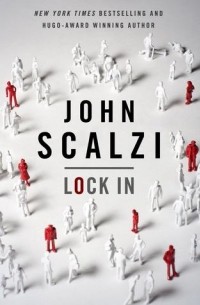
Отзывы о книге Lock In
 Asea_Aranion31 мая 2020
“Why would someone want to kill you?” Mom asked.
“I’m an FBI agent,” I said.
“It’s your third day on the job!”
“Fourth,” I said.
Before this one, the only thing by John Scalzi that I had read was “The Dispatcher” (here's my review), so I cannot tell if “Lock In” is really unlike the rest of the author's work as some reviewers have pointed out. However, the mentioned titles share a considerable likeness. First, in both cases we have some kind of universal health issue – the gift of resurrection in “The Dispatcher” or a pandemic disease in “Lock In” – coming out of nowhere, without much pondering on its origins. What interests the author is its further impact on the life of society. Scalzi seems to be quite thorough here, accounting for various levels from international politics to personal relationships. Second, an important consequence inter alia of such an usual situation is that some new professions are brought into existence – dispatchers and integrators, respectively – to deal with the affected people. Sure enough, one of those brand-new professionals and/or an affected person would be the main character of the story, to let us have the first-hand perspective. Both stories offer a pair of detectives, one experienced (funny enough, it’s always a woman) and one rookie, and I am not sure how but Scalzi makes you like them and want them to come back with another story. And here, too, it’s a match: there are sequels for both, although “The Dispatcher 2” has not been released yet.
As far as I’m concerned, if what you want from a book is to sit back and enjoy the ride, Scalzi is your man. It’s not so much an exercise in deduction as all action and pursuit, feeling more like a movie. “The Dispatcher” had a particular challenge – to function primarily as an audio performance – and therefore was delivered almost exclusively through dialogue. “Lock In” is not so limited, although the dialogues themselves show the same hand to have written them. But probably the novel just does not work best as an audiobook, or Zachary Quinto is simply a better reader than Wil Wheaton. Anyway there is a lot of slang and colloquial phrases which may be easier to grasp by sight than by ear. As for the tendency of putting “he said / she said” into each replica, that is also much less annoying when reading than listening. I wonder why those bits were not removed entirely by the editor, maybe if I was reading the book aloud to someone I would just ignore them, but I guess you can’t do that with an official Audible version :D that said, if you get “Lock In” on Audible it comes with a bonus novella describing the backstory, read by a full cast, which is an enthralling listen.
Another reason to read detective stories, I believe, is moral satisfaction – bad guys punished, balance to the universe restored. And again, both in “The Dispatcher” and this one, Scalzi is rather particular about moral implications of whatever sci-fi issues he presents. He is focused not on the technology but on how people feel about the technology, how it changes their self-perception, how it can be a way to personally improve ourselves. With “Lock In”, we have to consider what personality really means, to what extent appearance can define us, whether it is really possible to dissociate mind and matter. The question of gender identity is in fact addressed to in a pretty smart way, but if I tell you how exactly that may count as a spoiler 8)
Of course, reading Scalzi’s novel in 2020 adds another layer of interpretation. It does not really sound prophetic, but there are two points that draw attention: first, to get scientific research up and running and effective, you need a HUGE lot of money. The amount of actual funding nowadays, even raised due to the COVID-19 pandemic, does not even compare. Then again, the fictional President Haden of the US had a very personal motivation. And second, even if the Haden’s syndrome in the book has the same route of transmission as the coronavirus, being much more deadly at the same time, there is not even a hint of total lockdown or self-isolating that have actually happened in the real world. Isn’t that strange? Anyway, if you look for an optimistic book in a pandemic setting, this is the one (I don’t know if there are many). It implies that human nature in its best is highly adaptive and not so easy to crush, and if you really want to live a normal life, however drastic are the circumstances, it’s actually up to you. 13 понравилось788

Комментарии 0
Ваш комментарий
, чтобы оставить комментарий.
Комментариев пока нет,
ваш может стать первым