

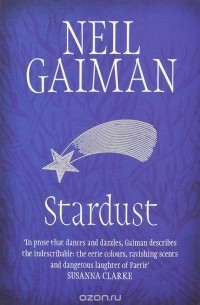
Отзывы о книге Stardust
 Mystery25 декабря 2019
Dark and mature fairy-tale
First of all, I would like to point out that I had seen the movie, adapted from this book, first, when it came out. It left an impression on me, being bright and unusual as it is. I’d describe it as a dark fairy-tale comedy and I expected this book to be something in this vein. I was certain that it would be a good, solid prose written cleverly and witty with flowing poetic language, using extensive vocabulary (because this is Neil Gaiman we’re talking about), and that at least the main events would play out like in the adaptation. While the first part of my expectations proved to be true, the second part, to my surprise, mostly wasn’t. A large part of the story, including the end, is nothing like the movie: Tristran’s entering a gap in the wall, Tristran’s journey (especially on the flying ship), star’s condition, deaths of the three brothers, Victoria’s confession, Tristran’s answer, Yvaine’s decision to look for Tristran in Wall, revelation of what could happen to her in Wall, realization of Tristran’s and Yvaine’s relationship, freeing of the bird-slave, Lady Una’s revelation to Tristran, final encounter with the witch-queen, the epilogue (the list could continue) — all of it is dealt with slowly, steadily and mostly anticlimactic, but a lot more fitting for a fable and more mature — more life-like. There are certainly more deaths and their descriptions are not pleasant, but this is another matter. And not only the events, the spirit of the book is different. It is more like a slow-paced dark fairy-tale, not a whirlwind adventure, almost absent of comedy, written with abundance of naturalistic detail: the author included descriptions how his characters eat (which is not uncommon), snore in their sleep (which is less common), have sex, take baths, piss (the most uncommon description in a fairy-tale), die in a very naturalistic manner and live with the consequences of their actions (such as living the rest of the life with a burned hand and a limp from a broken limb not perfectly healed), so that everything felt more material and real. And that, the aforementioned events, that differ, and its bittersweetness (especially towards the end) makes Stardust more mature than its live-action counterpart. In conclusion, the book is a worthy read if its qualities are what you’re after. As for me, while the overall mature approach is certainly interesting and the style is engaging, the ending is too anticlimactic to my taste.
 2 понравилось244

Комментарии 0
Ваш комментарий
, чтобы оставить комментарий.
Комментариев пока нет,
ваш может стать первым