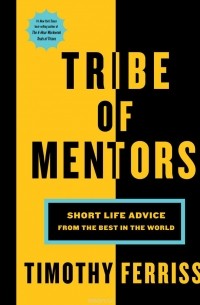
•What is the book (or books) you’ve given most as a gift, and why? Or what are one to three books that have greatly influenced your life?
2. What purchase of $100 or less has most positively impacted your life in the last six months (or in recent memory)? My readers love specifics like brand and model, where you found it, etc.
3. How has a failure, or apparent failure, set you up for later success? Do you have a “favorite failure” of yours?
4. If you could have a gigantic billboard anywhere with anything on it— metaphorically speaking, getting a message out to millions or billions— what would it say and why? It could be a few words or a paragraph. (If helpful, it can be someone else’s quote: Are there any quotes you think of often or live your life by?)
5. What is one of the best or most worthwhile investments you’ve ever made? (Could be an investment of money, time, energy, etc.)
6. What is an unusual habit or an absurd thing that you love?
7. In the last five years, what new belief, behavior, or habit has most improved your life?
8. What advice would you give to a smart, driven college student about to enter the “real world”? What advice should they ignore?
9. What are bad recommendations you hear in your profession or area of expertise?
10. In the last five years, what have you become better at saying no to (distractions, invitations, etc.)? What new realizations and/or approaches
helped? Any other tips?
11. When you feel overwhelmed or unfocused, or have lost your focus temporarily, what do you do? (If helpful: What questions do you ask yourself?)
•When I take the time to male a decision whether to take on an additional project, I refer to the list of my goals and see whether saying yes to an opportunity will take me toward or away from achieving that goal.
•Get out into the real dirt world and start failing. Why do I say that? Because the goal is to connect with your own self, your own soul. Adversity. Everybody spends their life trying to avoid it. Me too. But the best things that ever happened to me came during the times when the shit hit the fan and I had nothing and nobody to help me. Who are you really? What do you really want? Get out there and fail and find out.
•psychoanalytic psychotherapy
•When it comes to my work “yes” list, I think about what I might call the Epitaph Test. When I find myself with an opportunity, I ask myself whether I’d be happy if my epitaph had something to do with this project.
•Make sure I’m dedicating my time to the right people with the question, “Is this someone I might be thinking about when I’m on my deathbed?”
•Make sure I’m spending enough high-quality time with the people I care about most with the question, “If I were on my deathbed today, would I be happy with the amount of time I spent with this person?” An alternative is thinking about other people’s deathbeds—“If X person were on their deathbed today, how would I feel about the amount of quality time I’ve spent with them?”
•Eating Jar, Happiness Jar and others can help eliminate arguing in the family, as you can just take a look at restaurants or activity ideas which have always worked
•Whenever I am trying to decide whether to accept an invitation, I just pretend it is going to happen tomorrow morning.
•I avoid working on things that someone else could do, even if I enjoy doing it and would get paid well to do it. I try to give my best ideas away in the hope that someone will do them, because if they do them, that means I was not the only one who could have. I encourage competitors for the same reason. In the end, I’m left with projects that only I can do, which makes them distinctive and valuable.
•Don’t try to find your passion. Instead master some skill, interest, or knowledge that others find valuable. It almost doesn’t matter what it is at the start. You don’t have to love it, you just have to be the best at it. Once you master it, you’ll be rewarded with new opportunities that will allow you to move away from tasks you dislike and toward those that you enjoy. If you continue to optimize your mastery, you’ll eventually arrive at your passion.
•Somehow having an audience on social media feels like having a giant billboard for millions of people every day. I wish we could all start seeing it that way. I know so many people, for example, who were against Trump but were talking about him, criticizing, on their social every day. Would you put up a giant billboard of someone you don’t want to see elected? Probably not. We truly don’t understand social media.
•The worst recommendation that I hear in the influencer world is coming from marketing gurus who preach that if you build an audience and you start promoting brands to them, you can be extremely rich and successful. That’s cute, but remember the story of Bernays. Promoting unethical or unhealthy companies for money is not success, it is actually called “corruption.” Corruption of your belief system. Corruption of your legacy.
•Instead of considering every DM, every email as the most important thing in my life, I started looking at things as energy. Is this email empowering or is this email taking power out?
•If you ask a farmer in 20 years’ time about how they compete, it will depend on how they use information, from satellite imagery driving robotic field optimization to the code in their seeds. It will have nothing to do with workmanship or labor. That will eventually percolate through every industry as IT innervates the economy.
•I was called “la chica loca” (the crazy girl) so many times when I launched Endeavor that I finally decided to own it.
•Losing makes you think in ways victories can’t. You begin asking questions instead of feeling like you have all the answers.
•“No society in human history ever suffered because its people became too reasonable.”
•I hear constantly, “If you want to be the best, you need to do what the best are doing.” This couldn’t be further from the truth. If you want to get better in the sport, you need to work on your specific weaknesses, not those of someone who is successful.
•While we idolize the experts in our industry, we often forget that industries are often transformed by neophytes. The boldest transformations, like Uber disrupting transportation or Airbnb disrupting hospitality, are led by outsiders. Perhaps the playbook to change an industry is to be naive enough at the start to question basic assumptions and then stay alive long enough to employ skills that are unique and advantageous in the space you seek to change. Perhaps naive excitement and pragmatic expertise are equally important traits at different times.
•In the last five years, what new belief, behavior, or habit has most improved your life?
Asking myself the question, “When I’m old, how much would I be willing to pay to travel back in time and relive the moment that I’m experiencing right now?”
If that moment is something like rocking my six-month-old daughter to sleep while she hugs me, then the answer is anything: I’d literally pay all the money I’d have in the bank at, say, age 70 to get a chance to relive that moment. This simple question just puts things in perspective and makes you grateful for the experience you’re having right now versus being lost in thoughts about the past or the future.
•“Fly high.” In any given situation, I can’t control anything except my reaction and my contribution, so this mantra helps me to not deplete myself with lowbrow responses to problems. Most likely, the problem won’t be around in a year, but my reputation of how I dealt with it will.
•entertainment in general is always in a cyclical trend. I’ve realized that instead of following the trends, you want to identify the trends but not follow them. It’s good to recognize trends, but if you follow them, you get sucked into them, and then you also fall with the trend.
•What is one of the best or most worthwhile investments you’ve ever made?
Ever since I have had a home with a garage, I have had a gym in my garage
•Consequently, it is likely that most of what you currently learn at school will be irrelevant by the time you are 40.
•make mistakes, but don’t make the same mistake twice
•Most of the time, “What should I do with my life?” is a terrible question. Excellence is the next five minutes, improvement is the next five minutes, happiness is the next five minutes.



 1 понравилось