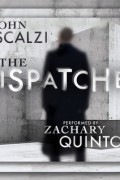
The story began with my rewatching Star Trek Beyond when it suddenly struck me that Zachary Quinto should try and perform audiobooks. I don’t know why I hadn’t thought of that before; surely the manner of speech is an important feature of his character, and Spock’s voice has always been clearly distinctive among the rest of the crew. I was really pleased to find out that in 2016 Zachary was actually offered such a challenge and took it, so there is at least one audiobook, not very long, but written by an award-winning author (yet unknown to me, though). To judge from the reviews, the first-timer’s performance was quite up to the stager’s writing.
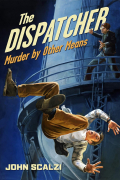
The Dispatcher is a 120-page novella created specially for reading aloud, which implies it is mostly dialogue, a kind of radio play. The publisher’s summary I found pretty confusing, to tell the truth, and only hoped I would manage to get into the story as it went. And it proved to be of no difficulty, after all. The narrative is highly skillful as much as it is minimalistic: apart from the lack of descriptions, there is not even an attempt of rationalization, and yet the essence and actualities of the dispatcher’s job are clearly delivered through natural conversation. I love it especially in fantastic literature when you are not presented paragraphs of straight “introduction to the problem”. The need to figure it all out from the storyline itself keeps you involved and alert. The Dispatcher is more or less a police procedural set in a world where only one thing is different from ours. A single idea played with by a master of pencraft: what if it is practically impossible to intentionally kill anyone? You may be surprised to realize that in this case, murder will become a way to save lives. If a person is killed on purpose, including by one of licensed “dispatchers”, he or she just comes back again – the matter-of-fact way people accept it in the story is probably the most plausible one: if a miracle just happens, you get to deal with it.
“It doesn’t bother you?”
“To live in the age of miracles?.. It was amazing the first few times when it happened. It’s still weird. But now it’s also my job. It’s hard to get all mystical about your job.”
That was a clever idea, in fact: to use killing as “resetting” terminal patients, for a chance to right medical errors, try another experimental therapy. Sounds like a blessing, and to be sure, this aspect of the story is a matter for very many of us. I remember Ann Druyan’s account of the illness and passing of her beloved husband Carl Sagan, which is given as an epilogue in his last book Billions and Billions : “I was torn between exhorting him to fight on and wanting him freed from the torture apparatus of life support and the demon that had tormented him for two years”. The fact is that forcibly “reviving” a person may be as good an instrument of abuse and torture as simply taking his life. There are three “dispatches” in the story done by the main character Tony Valdez, each with a different attitude: first, he calmly fulfills the terms of an insurance contract; second, he takes a quick decision for an unresponsive victim of a road accident; and finally, he leaves someone to die, respecting the man’s own decision.
“You can save him!”
“He doesn’t want to be saved.”
Anyway, the story which concerns death and violence has a practically happy ending and a life-asserting aftertaste. It is even plainly funny sometimes, like the phrase “He’d been married for forty-five years or some ridiculous number like that”, which I replayed several times and could not help giggling :)
If Zachary Quinto has time and mind to continue performing audiobooks, he may become a favourite of mine. The nature of this one gave him much freedom, and it was treated ably. There are ten or so speaking characters in the story, and each one has been granted a share of personality. On the other hand, this little performance is really more of a challenge than it may seem. In a movie, especially a sci-fi movie like the one that made Quinto widely famous, there is a lot to shift your attention: bright colours, extraordinary sceneries, special effects, other actors all in all. Here, no cheating: just what the performer can do totally on his own. Besides, reading is intimate. That’s why I like audiobooks, I believe: I always feel they are addressed directly to me. And if the narrator is someone I already admire, the tracks in my player are my very own little bit of him to enjoy. So that was truly well done, Zachary, thank you. There is now another character to associate you with, which I would trust and respect.



 104 понравилось